
Forget the familiar silhouettes of medieval domes and ancient stone crosses that define the Caucasian skyline. While Armenia’s monasteries are legendary, there is a singular place where the horizon shifts, trading monastic silence for the grand, rhythmic geometry of the Mediterranean.
The Temple of Garni is a 1st-century basalt masterpiece, standing as the only Greco-Roman colonnaded structure in the entire former Soviet Union. Perched defiantly on a triangular cliff in the Kotayk Province, it serves as a stunning reminder of Armenia’s pre-Christian soul—a sun-drenched sanctuary that survived the tides of religious change to become a royal summer retreat.
I still remember the sudden shock of seeing those 24 Ionic columns emerge from the rugged mountain fog, looking as if a piece of Athens had been carried by giants and dropped onto the edge of a jagged Armenian gorge. By 2026, the site has transformed into a world-class destination with upgraded facilities and evening light shows, but the real secret lies in timing your visit to catch the basalt turning gold before the crowds arrive.
Quick Facts: Temple of Garni (2026)
-
Location: Garni Village, Kotayk Province (45 mins from Yerevan).
-
2026 Entrance Fee: 1,500 AMD (approx. $4 USD); night visits with illumination may cost 2,000 AMD.
-
Best Arrival Time: 4:30 PM (to see the basalt turn orange and catch the new 2026 night lights).
-
Payment: Fully supports Apple Pay / Google Pay at the ticket gate.
How do you find the Temple of Garni and its hidden ruins?
You can find the Temple of Garni perched on a high triangular cliff overlooking the Azat River Gorge. On a map, look for the Kotayk Province just east of the capital. The location was chosen for its strategic defense, surrounded by deep canyons on three sides. This natural fortress protected the Armenian kings for centuries.
I find that many people only look at the main temple and leave. However, the real secret is the Roman Bathhouse located in the southwest corner of the fortress walls. I suggest walking past the main stairs of the temple to find this 3rd-century ruin. It contains a rare mosaic floor with a Greek inscription that translates to: “Working, we received nothing.” This 2,000-year-old complaint from a tired craftsman makes the history feel very human.
Beyond the baths, you should walk to the very edge of the cliff. From there, you can look down into the gorge at the “Symphony of Stones.” These are massive hexagonal basalt columns formed by ancient lava. In 2026, a new 20-minute hiking trail allows you to walk from the temple directly down to the base of these stone pipes.
Why is Garni the only pagan temple left in Armenia?
Garni survived the mass destruction of pagan temples in the 4th century because it was likely used as a royal summer house rather than just a religious site. When Armenia converted to Christianity in 301 AD, almost every other sun-god sanctuary was destroyed. I love the fact that the temple is dedicated to Mihr (Mithra), the god of the sun. The 24 Ionic columns were not just for decoration; they acted as a giant stone sundial, marking the 24 hours of a day.
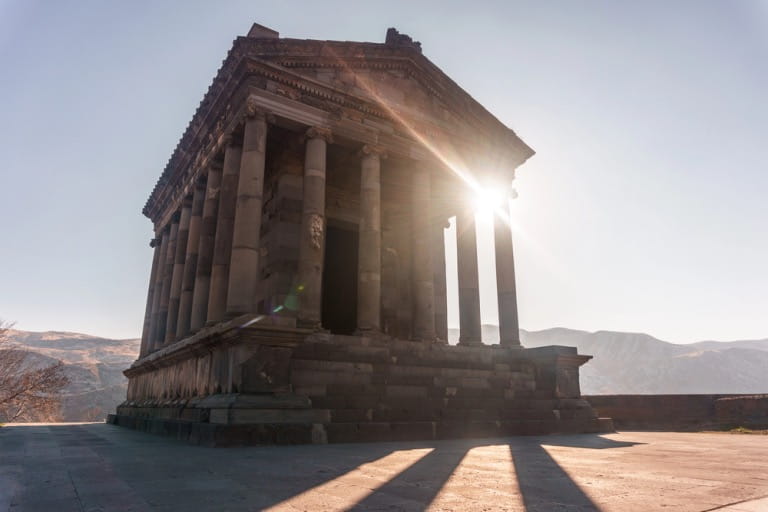
I noticed that the restoration work from the 1970s is a technical miracle. The temple collapsed during a huge earthquake in 1679 and lay in ruins for 300 years. Alexander Sahinian, a Soviet architect, rebuilt it using the “Anastylosis” method, fitting the original basalt pieces back together like a massive puzzle.
You can spot this yourself: look at the stones. The dark, weathered blocks are the 2,000-year-old originals, while the lighter grey stones are the modern pieces used to fill the gaps. This visual “treasure hunt” proves that Garni is a bridge between the ancient world and modern engineering. Standing inside the small inner chamber, you feel the weight of these basalt blocks, which were placed without any mortar.
How can you travel to Garni from Yerevan in 2026?
The best way to travel to Garni is by using the Yandex Go or GG apps, which cost about 4,000 AMD from central Yerevan. I always tell my friends to ignore the private drivers at Republic Square who ask for double the price. The apps provide a fixed rate and modern cars. In 2026, the village of Garni has implemented a new one-way traffic loop. If you are driving yourself, you should park in the official public lot at the village entrance rather than trying to drive to the temple gate.
I found that combining Garni with the nearby Geghard Monastery is the perfect 2026 day trip. You can take a taxi to Garni, spend two hours exploring, and then continue another 15 minutes up the road to Geghard. For budget travelers, minibuses (Marshrutkas) still leave from the Gai Bus Station for 500 AMD. However, the convenience of a taxi in 2026 is worth the small extra cost.
Beyond the Columns: The Perfect Garni One-Day Itinerary
To make the most of your trip in 2026, you need to think beyond the temple gate. Most tourists spend 30 minutes taking a selfie and leave, but the true magic of Garni is found in the connection between the architecture and the landscape. The ultimate 2026 itinerary starts at 2:00 PM in Yerevan. Grab a GG taxi and head straight to the temple. Spend your first hour identifying the “puzzle pieces” of Alexander Sahinian’s restoration and visiting the Roman baths to see the mosaic.
By 3:30 PM, exit the temple complex and follow the signs for the “Symphony of Stones” (Symphony of Columns). In 2026, the trail has been widened, making it a safe 20-minute descent into the Azat River Gorge. Standing at the base of these 50-meter-high basalt “organ pipes” is a humbling experience. I suggest walking along the riverbed to see where the volcanic rock meets the water. It is the best place to find peace before the evening crowds arrive.
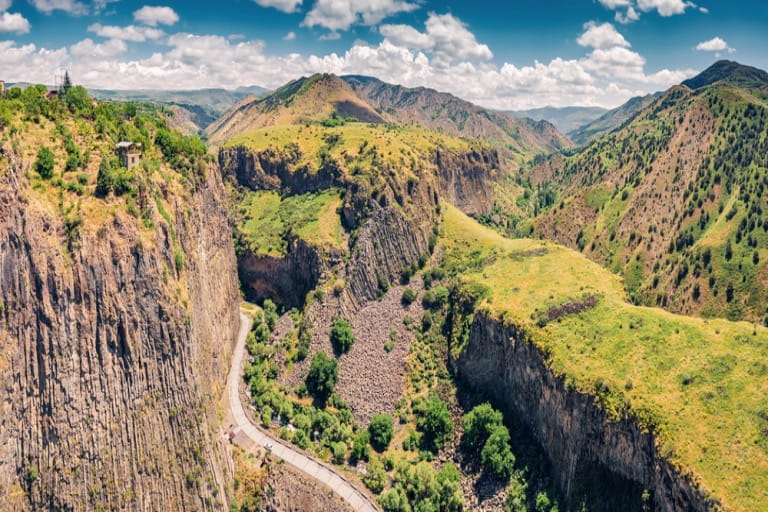
As the sun begins to set around 5:30 PM, hike back up or take one of the local 4WD “shuttles” back to the village for 1,000 AMD. This is the perfect time for dinner. Many local guesthouses now offer “Lavash-making masterclasses” where you can watch the traditional bread being baked in a subterranean tonir oven. After dinner, head back to the temple entrance. In 2026, the Garni Night Light Show starts after 7:30 PM. The basalt columns are illuminated with soft, golden LED lights that highlight the intricate acanthus leaf carvings in a way the sun never can. It is a hauntingly beautiful sight that bridges the gap between a 1st-century sanctuary and a 21st-century masterpiece.
2026 Visitor Tips & Hacks
-
Duduk Music: If you hear a flute-like sound inside the temple, it is the duduk. The acoustics of the basalt cella make the music sound incredibly spiritual.
-
Garni Gata: Do not leave without buying “Gata” bread from the local women outside the gate. Each village has its own style, but Garni’s version with sweet khoriz filling is famous across Armenia.
-
Footwear: Wear shoes with good grip. The basalt steps of the temple are very high and have been polished smooth by millions of feet over two millennia.
-
Offline Maps: Download the Kotayk region on Google Maps. While 5G is improving, signal can be weak once you descend into the deep Azat Gorge.
-
The “Secret” View: For the best photo of the temple against the canyon, walk to the very back of the complex, near the ruins of the 7th-century church.
Beyond the majestic colonnade, Garni remains a site where the raw power of nature and human ambition collide. Whether you are descending into the gorge to hear the “Symphony of Stones” or standing in the temple’s inner sanctum as the sun aligns with its ancient axis, Garni offers something rare in 2026: a chance to touch the pulse of a pagan past that refused to be forgotten.
