
Mariem Mhadhbi is the co-founder and CEO of ValueCo, also known as ValueCoMetrics, a fintech and ESG data company focused on measuring the market value of sustainability. She is known for connecting financial markets, ESG data, investor perception, and capital-market decision-making.
Her work asks a sharp question: how can sustainability be measured as real market value? That question is what makes her profile stand out. She is not only an ESG speaker or startup founder. She is a financial markets expert building a company around the idea that environmental, social, and human factors should be more visible in investment decisions.
Quick Facts About Mariem Mhadhbi
| Detail | Information |
|---|---|
| Full name | Mariem Mhadhbi |
| Known for | CEO and co-founder of ValueCo |
| Company | ValueCo / ValueCoMetrics |
| Field | ESG data, fintech, sustainable finance |
| Background | Financial markets |
| Experience | 13+ years across markets and investor-facing roles |
| Education | Ecole des Mines, INSEAD, MIT |
| Core idea | Measuring sustainability’s market value |
| Company purpose | Helps investors and companies connect ESG performance with market perception |
| Co-founder | Mathieu Joubrel |
| Funding | ValueCo raised €1.5M in 2024 |
| Net worth | Not publicly confirmed |
| Public role | Founder, speaker, ESG data and sustainable finance voice |
This gives the quick answer. Mariem Mhadhbi is not a generic sustainability commentator. Her public identity is tied to ESG measurement, financial markets, and ValueCo’s attempt to make sustainability more visible in market analysis.
What Is ValueCo?
ValueCo is a fintech and ESG data company that helps investors and companies understand how sustainability is valued by the market.

Its core idea is simple: ESG should not remain only in reports, ratings, and corporate language. It should become something investors can compare, discuss, and use more clearly in financial decisions.
ValueCo focuses on connecting sustainability performance with market perception. In other words, it looks at how investors understand ESG performance, how companies communicate sustainability, and how those signals may affect trust, risk, reputation, and value.
That makes ValueCo different from a traditional ESG content platform. It is trying to turn investor perception into usable data.
Why Does Mariem Mhadhbi Matter in ESG and Capital Markets?
Mariem Mhadhbi matters because she focuses on the gap between ESG promises and market value.
For years, ESG has often been treated as a reporting issue. Companies disclose. Rating agencies score. Investors compare. But the difficult question remains: does the market actually reward better sustainability performance?
This is where Mhadhbi’s background matters. She comes from financial markets, not only from climate advocacy or corporate communications. Her work is not simply about saying sustainability is good. It is about understanding whether sustainability affects value, risk, trust, and investor behavior.

From Financial Markets to ValueCo
Mariem Mhadhbi’s career path helps explain why ValueCo is built around investor perception rather than vague ESG language.
Her professional identity is strongly connected to finance, data, and sustainability. She places ESG inside the logic of capital markets: how investors interpret sustainability, how companies communicate it, and how market expectations influence value.
This background also explains why she appears on speaker pages for data, AI, finance, and innovation events. Her topic is not only “green business.” It is also about market intelligence, investor behavior, and performance measurement.
In simple terms, Mhadhbi’s work tries to move ESG from a moral statement into a measurable business signal.
ValueCo’s Funding and Startup Credibility
ValueCo gained stronger startup credibility after raising a €1.5 million equity funding round in 2024.
This funding matters because it shows ValueCo is not only a concept. It has raised capital to build its ESG market-value approach.
For a company trying to make ESG more measurable, funding also signals that investors see demand for better sustainability intelligence. It gives ValueCo more credibility as a startup working at the intersection of finance, data, and sustainable business.
Why Is Measuring Sustainability’s Market Value Important?
Measuring sustainability’s market value matters because companies and investors need more than ESG slogans.
A company can say it is responsible. A fund can say it is sustainable. But markets need better ways to judge whether those claims are credible, priced, or trusted by investors.
This is especially important when companies face greenwashing concerns, inconsistent ESG ratings, and pressure to prove that sustainability commitments are more than public relations.
How Is ValueCo Different From Traditional ESG Ratings?
ValueCo’s direction is different because it focuses less on static ESG labels and more on how markets perceive sustainability performance.
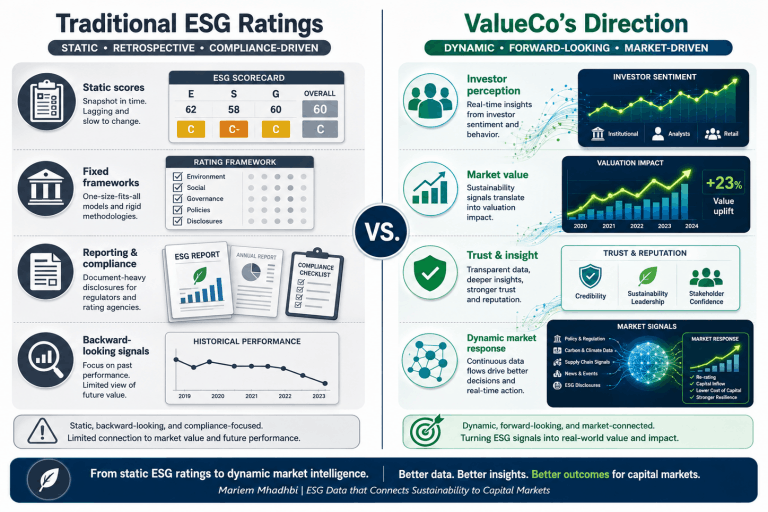
| Traditional ESG Ratings | ValueCo’s Direction |
|---|---|
| Score companies through fixed frameworks | Looks at investor perception |
| Can feel static or backward-looking | Connects ESG signals with market value |
| Focuses on reporting and compliance | Focuses on trust, insight, and valuation |
| May be hard for companies to act on | Helps companies understand market response |
This distinction matters because Mariem Mhadhbi’s work is not only about saying ESG is important. It is about making ESG more visible inside capital-market logic.
Mariem Mhadhbi Career Timeline
Mariem Mhadhbi’s career is best understood as a move from financial markets to ESG data entrepreneurship.
| Stage | What It Shows |
|---|---|
| Financial markets background | Built expertise in markets, performance, and investor-facing questions |
| Education | Linked to École des Mines, INSEAD, and MIT |
| ESG focus | Became associated with measuring sustainability in financial terms |
| ValueCo founding | Co-founded ValueCo with Mathieu Joubrel in 2022 |
| Funding milestone | ValueCo raised €1.5 million in 2024 |
| Public voice | Speaks on ESG, finance, data, AI, and sustainability value |
This path shows why her story is not just about founding a company. It is about bringing a financial markets mindset into the sustainability debate.
What Is Mariem Mhadhbi’s Net Worth?
Mariem Mhadhbi’s net worth is not publicly confirmed. As the co-founder and CEO of ValueCo, her financial profile is likely connected to founder equity, company growth, and the long-term value of the startup rather than a publicly reported personal fortune.
ValueCo’s €1.5 million funding round adds credibility to the company, but company funding should not be treated as personal wealth. The clearest public information is tied to her role in ESG data, sustainable finance, and ValueCo’s growth, while her personal net worth remains private.
FAQ About Mariem Mhadhbi
1. Who is Mariem Mhadhbi?
Mariem Mhadhbi is the co-founder and CEO of ValueCo, a fintech and ESG data company focused on measuring the market value.
2. What is ValueCo?
ValueCo helps investors and businesses understand how ESG commitments and sustainability factors relate to market value and investor perception.
3. What is Mariem Mhadhbi known for?
She is known for connecting financial markets, ESG data, investor perception, and sustainability valuation through ValueCo.
4. Who founded ValueCo?
ValueCo was founded by Mariem Mhadhbi and Mathieu Joubrel in 2022.
5. Did ValueCo raise funding?
Yes. ValueCo raised a €1.5 million equity funding round in 2024, which strengthened its startup credibility in ESG data and sustainable finance.
6. What is Mariem Mhadhbi’s net worth?
Mariem Mhadhbi’s net worth is not publicly confirmed. Her financial profile is likely tied to founder equity, ValueCo’s growth, and the company’s long-term value.
Conclusion
Mariem Mhadhbi matters because she is helping move ESG from reporting language into capital-market logic. Through ValueCo, she connects financial-market experience, investor perception, sustainability data, and company value.
Her work asks whether sustainability can be measured clearly enough to influence how markets understand risk, trust, and long-term value.
